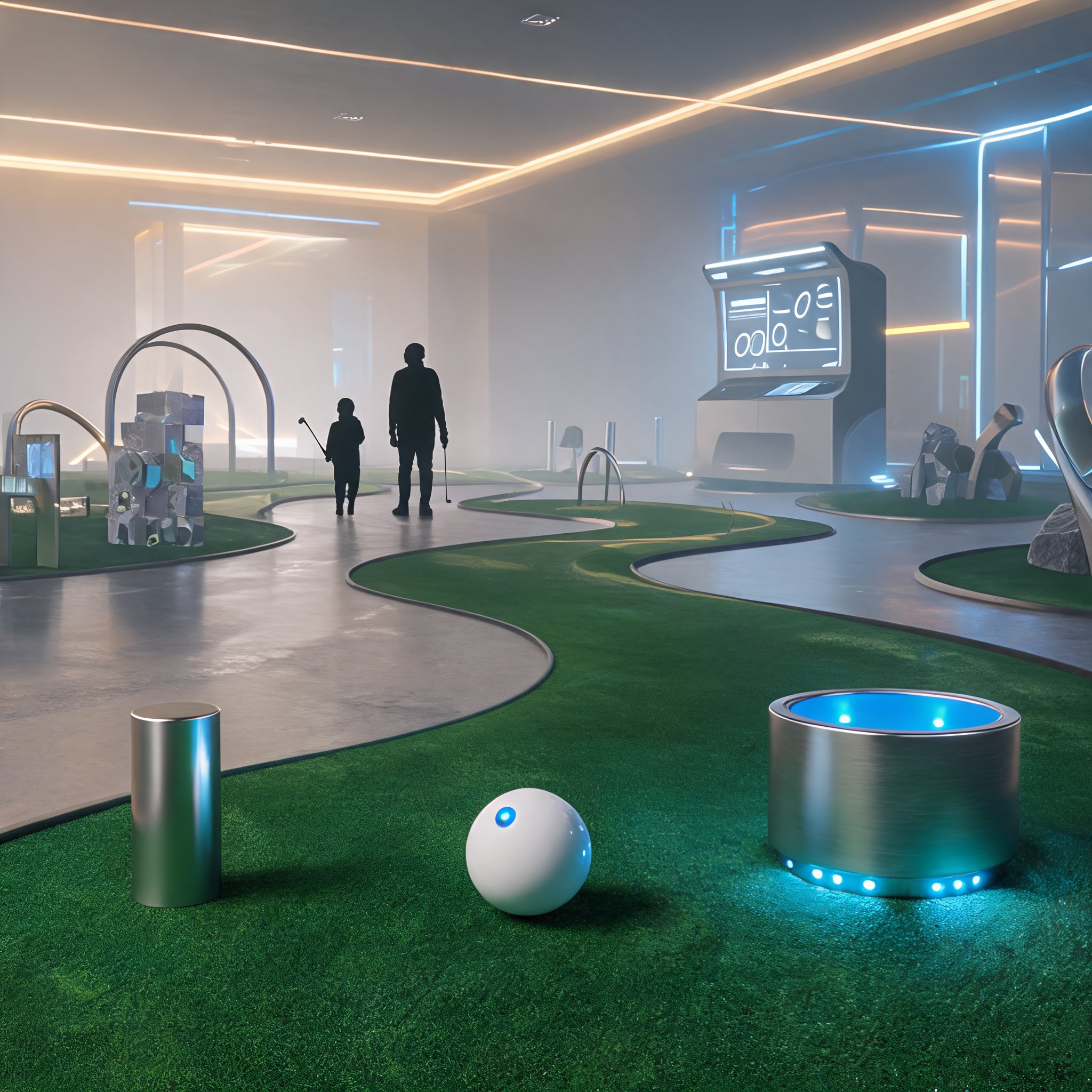
Holovis is repositioning its 360Golf brand from a technology-enhanced putting game into what it calls a connected game platform. The core activity remains mini golf, but automated scoring, persistent player accounts, gamified challenges and an analytics engine now sit on top of the course. Holovis is presenting the format at IAAPA Expo and the Land Leisure & Tourism Show, and says implementations already span the UK, Europe, the Middle East, North America and Asia Pacific. The proposition is less about inventing a new leisure category than about making an existing one easier to operate, easier to replay and easier to measure. That positioning also explains why the company talks about venues, throughput and food-and-beverage revenue as readily as it talks about holes and putters.
A familiar game with a low-friction digital layer
Mini golf provides the familiar frame. According to Stuart Edgington, Holovis' global director of business development, the game is already one of the world's most accessible leisure activities, so the company does not need to reinvent its fundamental appeal. Instead, 360Golf adds a digital layer that is meant to feel effortless. Visitors register, collect an assigned smart ball and begin playing. Smart balls, tees and cups work with the HoloTrac scoring system, which removes paper scorecards and acts as a referee when competition is fierce. The company says the process requires little explanation or staff time. That low-friction entry is central to its intergenerational pitch: families, competitive-socialising young adults and corporate groups can use the same course without separate systems or extensive briefing.
Gamification is designed for return visits
Automated scoring alone would be a utility. 360Golf layers on SuperShots, which offer alternative ways to score, and Triumphs, which present awards and unlock new challenges. These are supported by bonuses, on-course games, player accounts, achievements, leaderboards and video celebrations. Matt Dobbs, business development director, says the aim is to give players more reason to compete, celebrate and compare scores, and therefore more reason to return. The design intent is clear: accounts and leaderboards turn a single round into part of a continuing profile, while awards and challenges give operators a reason to refresh the experience. The repeat-visit effect is therefore best treated as a product strategy and company claim rather than an independently verified outcome.
DeepSmarts turns play into operations data
The DeepSmarts AI engine is the operational layer beneath the game. Holovis says it can provide insight into uptime, player interaction and seasonality, and suggest where operators might tweak their operations. It can support promotions aimed at quieter periods or underserved demographics, and help engineers diagnose problems remotely when a venue reports unexpected behaviour. The system is designed to optimise capacity at up to 80 people per hour per course. A kiosk-based flow lets guests understand the game, collect a ball and play, leaving staff to manage guests and food and drink. That is the commercial heart of the platform: scoring generates data, data supports throughput and secondary spend, and a smoother front end protects labour capacity. The value still depends on how well an operator uses the analytics and integrates them into daily management.
Flexible deployment, uneven economics
The platform can be delivered as a technology-only retrofit for existing mini golf attractions, as a selection of catalogue holes, or as a fully bespoke course. Holovis quotes installation schedules of about six to eight weeks for tech-only deployments, eight to 12 weeks for off-the-shelf catalogue holes, and upwards of six months for custom projects. At Butlin's Bognor Regis resort, the £15m PLAYXPERIENCE indoor activity centre opened in 2024 with three nine-hole 360Golf courses: one with neon glow effects, a Las Vegas-themed challenge and a wheelchair-accessible music-themed course. Dobbs says the tech-putt offering has exceeded the client's expectations, with 5,000 players in a busy week and around £40,000 in weekly gross revenue. That is a striking illustration of throughput, but it is one company-provided example, not a universal benchmark. Smaller venues can choose a more cost-effective design while retaining scoring and replayability, Holovis says.
Customisation and inclusion are part of the product
Custom work shows how far the platform can be adapted. The Top 9 course at Netflix House is a fully custom, IP-led installation with unique hole designs and interactive elements tied to themes including One Piece, Squid Game and Floor is Lava. For Norwegian Cruise Line, 360Golf has delivered four installations under the Tee Time brand, using marine-grade, IP-rated technology, rugged cups and tees and specialist screens for use at sea. In Norway, a Lucky Duck project offers two routes for each hole. At Butlin's, inclusive design includes right- and left-handed play, putter sizes for tall guests, wheelchair access and a drop-down top cap, tee placement close enough to the edge for guests who cannot get onto the course, and spacing between holes to reduce overcrowding and safety hazards. These details show that 360Golf is not only software; physical design, lighting, engineering and content are part of the same package.
Multi-site consistency and service support
For multi-site operators such as Saudi Entertainment Ventures, the technology provides a common base while allowing variation in theming, course layout or branding. Edgington says the core system can be networked across locations, giving operators consistency without forcing every site to look the same. 360Golf is also designed for easy maintenance, with a robust and repairable approach intended to increase longevity and sustainability. Remote diagnostics add a service layer: if something goes wrong, Holovis says its engineers can observe the course and identify the issue. This matters for operators running attractions across several venues, where inconsistent equipment or slow fault-finding can erode both guest experience and staff confidence. It also supports the wider pitch that 360Golf is a managed platform rather than a one-off course purchase.
Where the platform strategy meets its limits
Holovis is already looking beyond mini golf. The team is working with Roxy Leisure to add stroke-counting technology to crazy pool tables, and Maaz Ussen, project manager, says the ambition is to apply the technology to other sports. Edgington also expects competitive socialising eventually to reach peak saturation, which helps explain the search for adjacent markets and new formats. The sales conversation Holovis describes is turnkey: venue restrictions, audience focus, catalogue versus custom design and commercial modelling all shape the proposal. That makes 360Golf more than an equipment sale, but it also means results are site-specific. Claims about dwell time, food-and-beverage revenue and return on investment are commercial arguments that depend on location, pricing, operations and content refresh. The platform's strength is integration; its proof will come venue by venue.