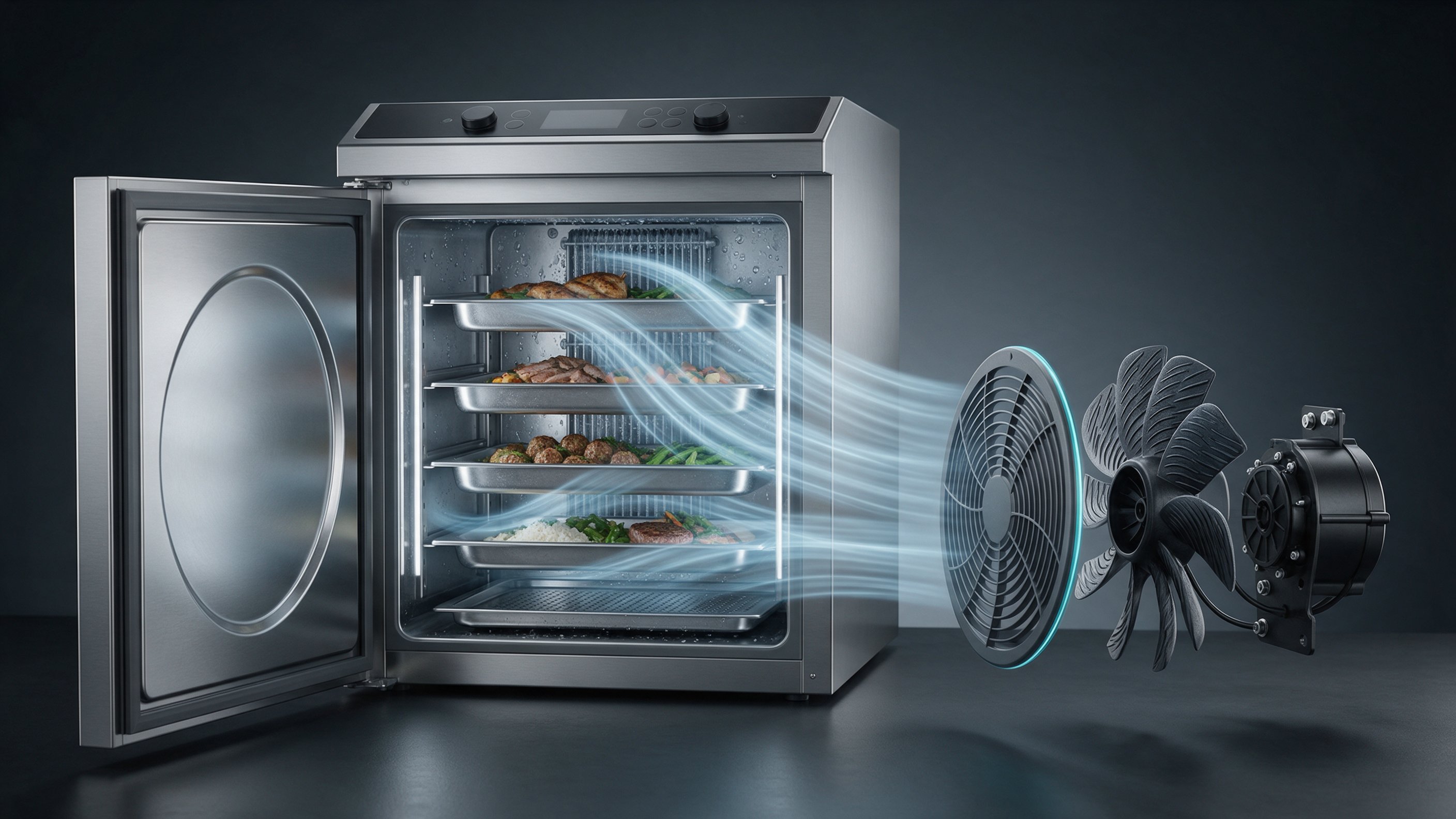
Blast chillers are moving from a specialist corner of professional kitchens into the centre of refrigeration system design, as operators weigh food safety obligations against rising electricity costs and tightening European rules on energy-related products.
The core function is unchanged: cold air is circulated intensively around food to pull temperatures down quickly. In current-generation equipment that means dropping product from more than 70°C to below 3°C in as little as ninety minutes — a speed that has made rapid cooling standard practice across catering, hospitals, hotels and food processing plants.
Why the cooling window matters
After cooking, food passes through what the industry calls the danger zone, roughly 63°C to 4°C, where microorganisms find ideal conditions to multiply. Shortening the time spent in that band is a founding principle of HACCP, the hazard analysis system widely applied in food manufacturing and professional catering. Beyond compliance, rapid cooling is credited with limiting bacterial growth, extending shelf life and better retaining texture, moisture, aroma and nutritional value, while also simplifying production planning and reducing waste.
Airflow rather than refrigeration circuit alone
Performance discussions usually start with the compressor or evaporator, but heat transfer only works when cold air reaches the whole load evenly. Zones of low air velocity or turbulence leave parts of a product cooling more slowly than others, and those differences put food safety, cycle times and final quality at risk.
That has pushed the fan from a secondary component to a determinant of overall efficiency. Electronically commutated (EC) motors combine high electrical efficiency with continuous speed control, letting airflow follow each stage of the cooling cycle. Paired with biomimetic impeller designs and composite materials, the combination is presented as delivering more uniform cold-air distribution and lower energy use, either by shortening cooling time or by avoiding nominal-rate operation, and in some cases by replacing bulky external controllers that occupy chamber space.
- Improved turbulence control is claimed to reduce noise and improve working conditions.
- Lower heat generation from the motors is said to raise refrigeration system performance.
- Less mechanical stress and finer control are presented as extending service life and cutting maintenance requirements.
Digital control and traceability
Current units can select programs according to the food being processed, track temperature evolution through probes and log the entire cycle for audits. Open protocols such as Modbus allow integration into kitchen infrastructure and building management systems, so temperatures, fan speeds, operating hours and energy consumption can be monitored remotely. Continuous analysis of those parameters is intended to flag deviations before they turn into failures.
The regulatory horizon
European energy and carbon objectives are reshaping the rulebook. The Ecodesign framework is broadening beyond energy performance to cover durability, repairability and digitalisation, and the Ecodesign for Sustainable Products Regulation (ESPR) is described as a turning point for equipment development. Measures will arrive progressively, but the 2026 horizon is already influencing design decisions, with efficiency judged on how motors, fans, heat exchangers and electronics interact rather than on the refrigeration circuit alone.
New roles across the supply chain
Fan and motor specialist ZIEHL-ABEGG is cited as an example of the collaborative model, supplying EC axial fans for commercial refrigeration and food service that combine efficient motors, aerodynamic design, low noise and open-protocol communication. The broader implication is that installers increasingly need electronics, connectivity and control expertise to serve customers who want lower operating costs and high reliability, not just cooling capacity.
Food safety remains the non-negotiable objective. The emerging requirement is to reach it with less energy, more connectivity and enough flexibility to absorb further regulatory change — an integrated design problem rather than a single-component specification.