The Canadian Sphagnum Peat Moss Association's Sept. 17 report, covering harvest conditions through Aug. 31, shows Canadian peat extraction varying widely by region rather than falling short in a uniform way. Alberta reached 56% of expected extraction, Manitoba 79%, Saskatchewan 90%, Québec's North and South Shores 77%, Southern New Brunswick 70%, Northern New Brunswick 85%, and Ontario 90%. Prince Edward Island, Newfoundland and Labrador, and Nova Scotia were reported as significantly below expected levels.
CSPMA attributes much of the shortfall to wet weather. Just as important, the association says careful inventory management should allow producers to meet customer needs. That distinction matters: the report is not a declaration of a peat shortage.
What "Expected Extraction" Actually Measures
The more useful question for growers is not whether peat will run out, but how resilient a growing-media strategy is when one depended-upon material becomes harder or more expensive to secure. It helps to understand what the CSPMA figure represents. "Expected extraction" is not the amount of available peatland that was harvested. It is the volume producers calculated they needed for the season: market requirements plus the desired year-end inventory buffer, minus inventory carried into 2026.
The Risk Extends Beyond Peat
Peat is only one part of a broader supply picture. Climate affects harvest and biomass availability. Labor affects harvesting, processing and transportation. Freight can change the economics of a material long before its FOB price changes. Transportation is especially difficult now. The Wall Street Journal reported in late September that U.S. contract trucking rates averaged $3.11 per mile in August, including fuel surcharges, up 29% from a year earlier. Diesel, driver availability, rail surcharges and ocean freight are all adding volatility, which for a bulky input such as growing media can quickly change the answer to a sourcing decision.
Dr. Charlie Hall has made a similar point from the broader grower-cost perspective. In a recent Greenhouse Grower interview, Hall emphasized supply-chain agility, backup suppliers and working-capital discipline as growers plan for 2027. His Index of Prices Paid by Growers is useful precisely because the cheapest input on paper is not necessarily the lowest-risk or lowest-cost decision once freight, inventory and operational impacts are included. The implication is that raw-material selection should stop being a once-a-year purchasing exercise and start being a risk-management and production-design decision.
Design From Crop Character Back to Ingredients
Growing media is often built in the opposite direction from what makes sense. The familiar approach starts with what is available — peat, coir, bark, wood fiber, perlite or another component — and builds a mix around those ingredients. A better starting point is the crop: how much water holding, how much air porosity, what structural stability is required through the cycle, how the material must rewet, what buffering and chemistry the crop and irrigation program can tolerate, and how uniform it must be for automation. Once those requirements are clear, the ingredients and percentages that can create that character follow.
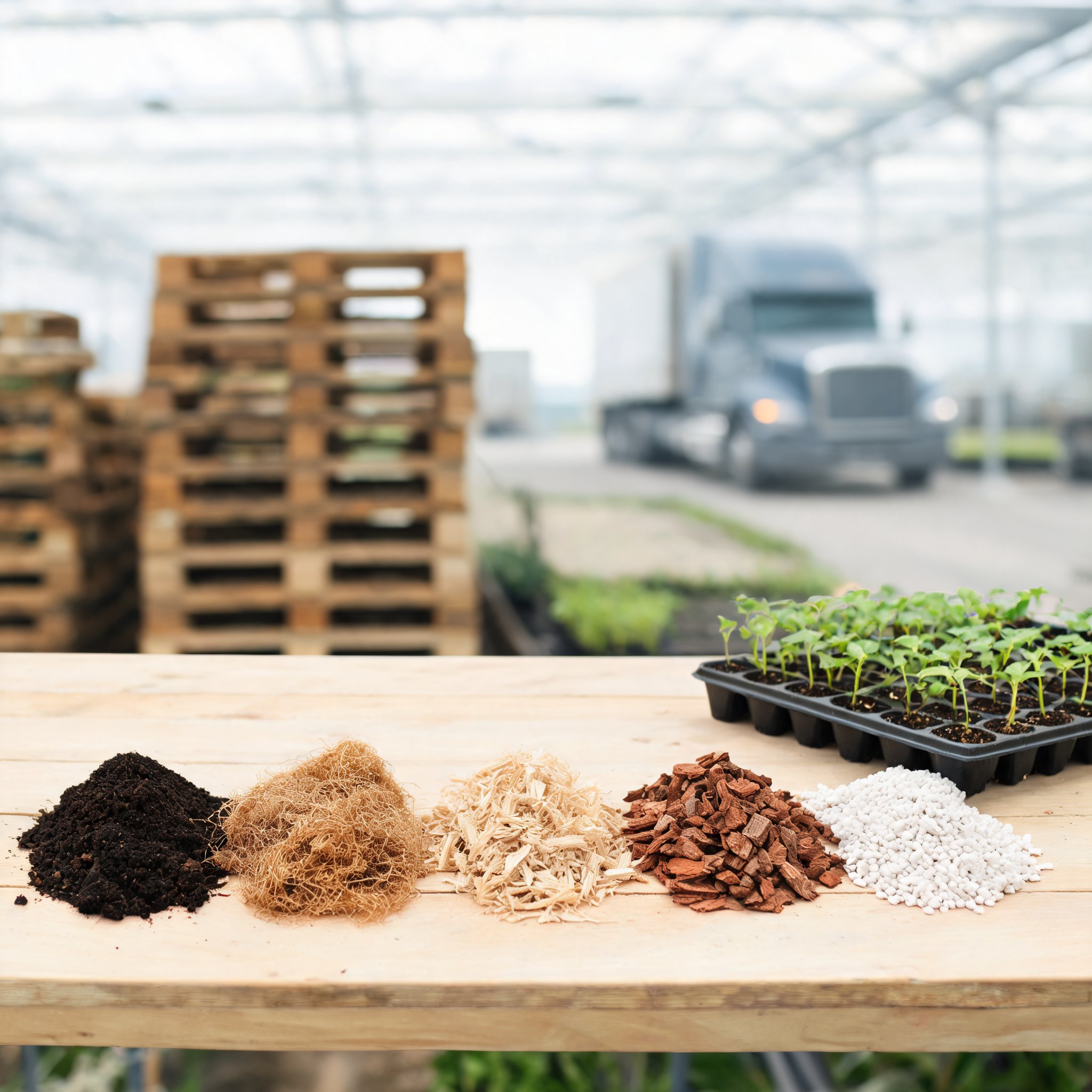
This matters because the raw-material toolbox is getting larger. Wageningen University & Research's 2026 work on the future of growing media identifies market-accepted materials such as coir, coniferous wood fiber, bark, compost and perlite, along with less familiar candidates including other plant fibers, biochars, co-composts and reused growing media. The researchers note that many new materials require processing, sanitization and stabilization before they become reliable horticultural inputs. Availability is not the same as suitability, but suitability is increasingly something that can be engineered.
Revisiting Materials Once Ruled Out
Processing technology has improved across coir, wood fiber, bark and other biomass streams. Materials that were too inconsistent, too wet, too coarse, too salty, too difficult to handle or simply too expensive several years ago may deserve another look, as may regional agricultural residues that can be cleaned, screened, fiberized, composted or otherwise processed into more consistent ingredients. That is not an argument for replacing a proven substrate simply because something new exists, but for knowing what else is available before it is needed.
A material also does not have to make up 30% or 40% of a formulation to be useful. In some systems, a 5% or 10% inclusion may be enough to change cost, water behavior, structure, rewetting or supply exposure. The right rate is a crop and system question rather than a universal prescription, and any new component needs to be trialed and validated before commercial adoption. Small trials become strategic here: an alternative wood fiber, rice hulls, bark fractions, coir products or locally available biomass, each tested for what changes in irrigation, fertility, handling and crop performance.
Local and Global as a Portfolio, Not a Choice
Interest in sourcing closer to home is understandable. Regional materials can reduce transportation exposure and create flexibility, particularly when processed near the point of use. But "local" is not automatically better, just as "imported" is not automatically risky. Coir travels a long distance yet can offer characteristics that are difficult to reproduce with some local materials, and peat remains an extraordinarily important and effective component. The more resilient strategy is likely a portfolio: dependable core materials, strong supplier relationships, some regional options, some globally sourced options, and enough formulation knowledge to adjust without losing the root-zone character the crop requires.
Use 2026 as a Planning Signal
The lesson from this year's Canadian harvest is not that growers should move away from peat. CSPMA itself says inventory management should allow producers to meet customer requirements. The lesson is that the conditions behind raw materials can change quickly while crops still have to be produced on schedule. Weather, labor, freight, tariffs and supply-chain disruptions have supplied enough reminders that yesterday's dependable supply pattern is not guaranteed to remain tomorrow's. Growing-media demand is also expanding: Wageningen research projects global demand rising substantially toward 2050, which implies a need for a broader basket of materials and more processing capacity rather than a different winner in the peat-versus-coir-versus-wood-fiber debate.
For growers planning 2027, that suggests a few practical questions: which raw materials are most exposed in the current formulation, what is their true delivered cost, which characteristics are essential to the crop, what other ingredients could deliver part of that function, and which of those should be trialed now. The best time to build flexibility into a growing-media program is while choices remain. Jennifer Neujahr is the former Director of Horticulture Business for Profile Products and, with Ted Buis, co-founder of Next Step Solutions, a growth accelerator focused on horticulture and AgTech.