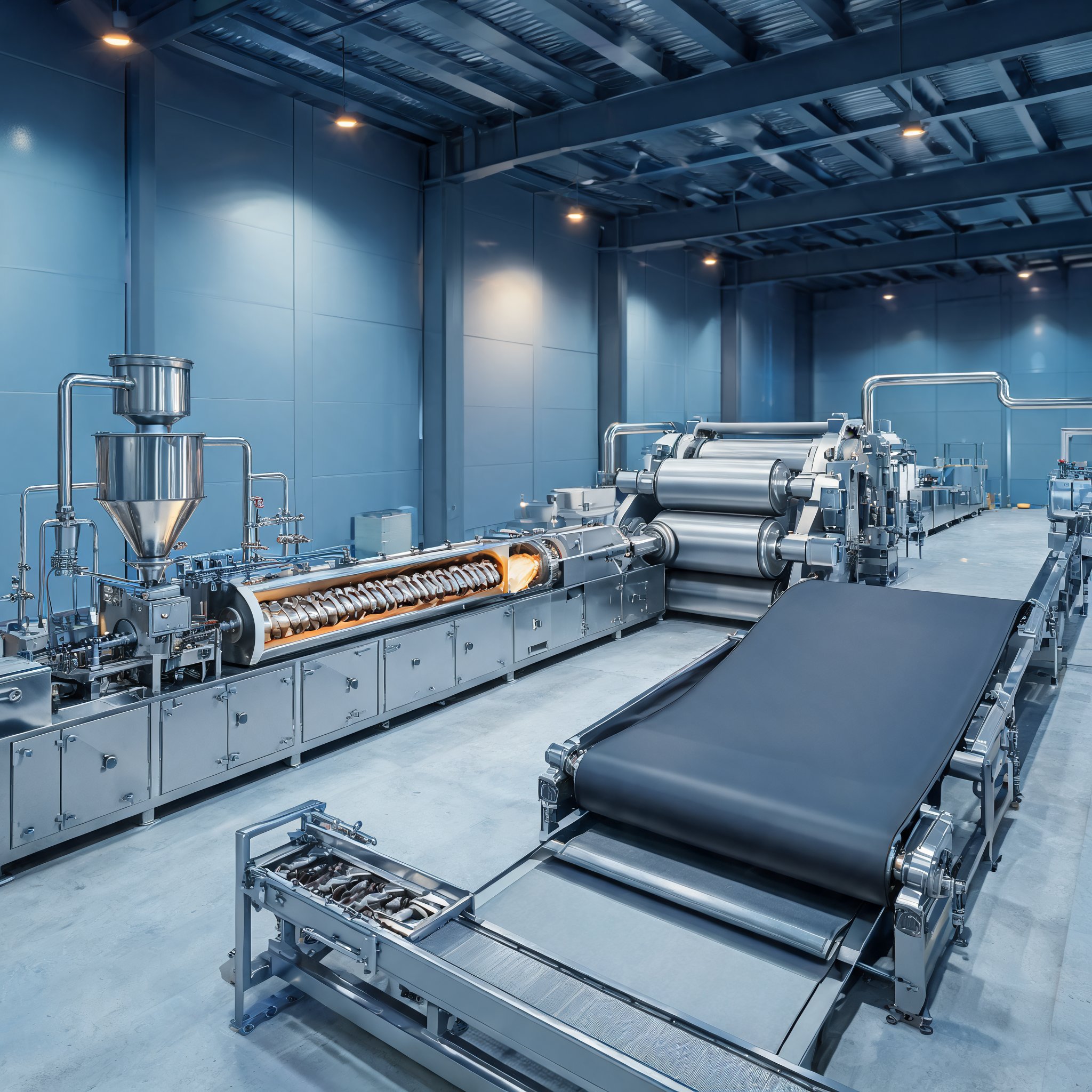
KraussMaffei Extrusion has developed a continuous single-stage process for making PVC roofing membranes, called PVC InlineMixing, that replaces the conventional two-step route built around a separate heating-cooling mixer. The company says the approach can cut energy use, shorten production time and improve the economics of membrane manufacturing.
In the traditional sequence, PVC powder, plasticizers, additives and fillers are mixed batchwise in a hot-cold mixer to create a dryblend. That material is cooled, stored and later plasticized in a twin-screw extruder before being formed into membrane. PVC InlineMixing removes the separate mixing and intermediate storage step. Solid and liquid ingredients are instead fed directly into the extruder through gravimetric dosing systems, in the proportions required by the formulation.
Lower energy and operating costs
According to KraussMaffei Extrusion, the single-stage layout avoids investment in a separate heating-cooling-mixing combination and heats the material only once. The company reports that energy consumption, and therefore energy costs, can be reduced by up to 75%, depending on the formulation, system parameters and location. Because the separate mixer is eliminated, the process also requires less floor space and fewer staff than a dryblend-premixing system, while maintenance needs fall because wear parts for the heating-cooling mixer are no longer required.
The company frames the combination of lower capital expenditure and lower operating costs as the basis for a faster return on investment. These are company claims tied to the process configuration; the actual result for a given plant will depend on formulation, equipment and site conditions.
Formulation changes during operation
KraussMaffei says the continuous process also gives manufacturers more flexibility. Formula adjustments and color changes can be made directly during operation through the integrated control system, avoiding the preparation and interim storage of separate dryblend batches. Christopher Bartel, head of sales for flat and foam at KraussMaffei Extrusion, said the approach offers membrane producers lower production costs, greater flexibility and more efficient manufacturing, allowing them to respond faster to new requirements and adjust formulations during production while reducing energy and capital expenditure.
Tests and industrial reference
The process was developed at the KraussMaffei Extrusion Technology Center in Laatzen and validated with industrial roofing-membrane formulations. The trials used a co-rotating twin-screw extruder from the ZE 65 BluePower series, equipped with loss-in-weight feeders for all solid components and multiple liquid feeders for free-flowing ingredients. The ZE BluePower series has a Da/Di ratio of 1.65; the company says the combination of high torque and large free volume creates a broad process window for different formulations.
KraussMaffei reports that the tests produced excellent PVC gelation and high product quality. The mechanical properties and weldability of the membranes also met industrial requirements across several formulations. In addition, PVC InlineMixing is already running in an industrial production line for PVC roofing membranes. That reference plant uses two extruders and two calenders to reach a total throughput of 1,800 kg/h, processing PVC, additives, fillers and edge trimmings continuously into finished membrane.
The company presents PVC InlineMixing as a way to combine product quality with a leaner production route. For membrane manufacturers, the significance lies less in a single equipment change than in the removal of a batch mixing and storage step from the overall process. The open question for each producer is how much of the reported energy, labor and space advantage can be realized with its own formulations and plant configuration.