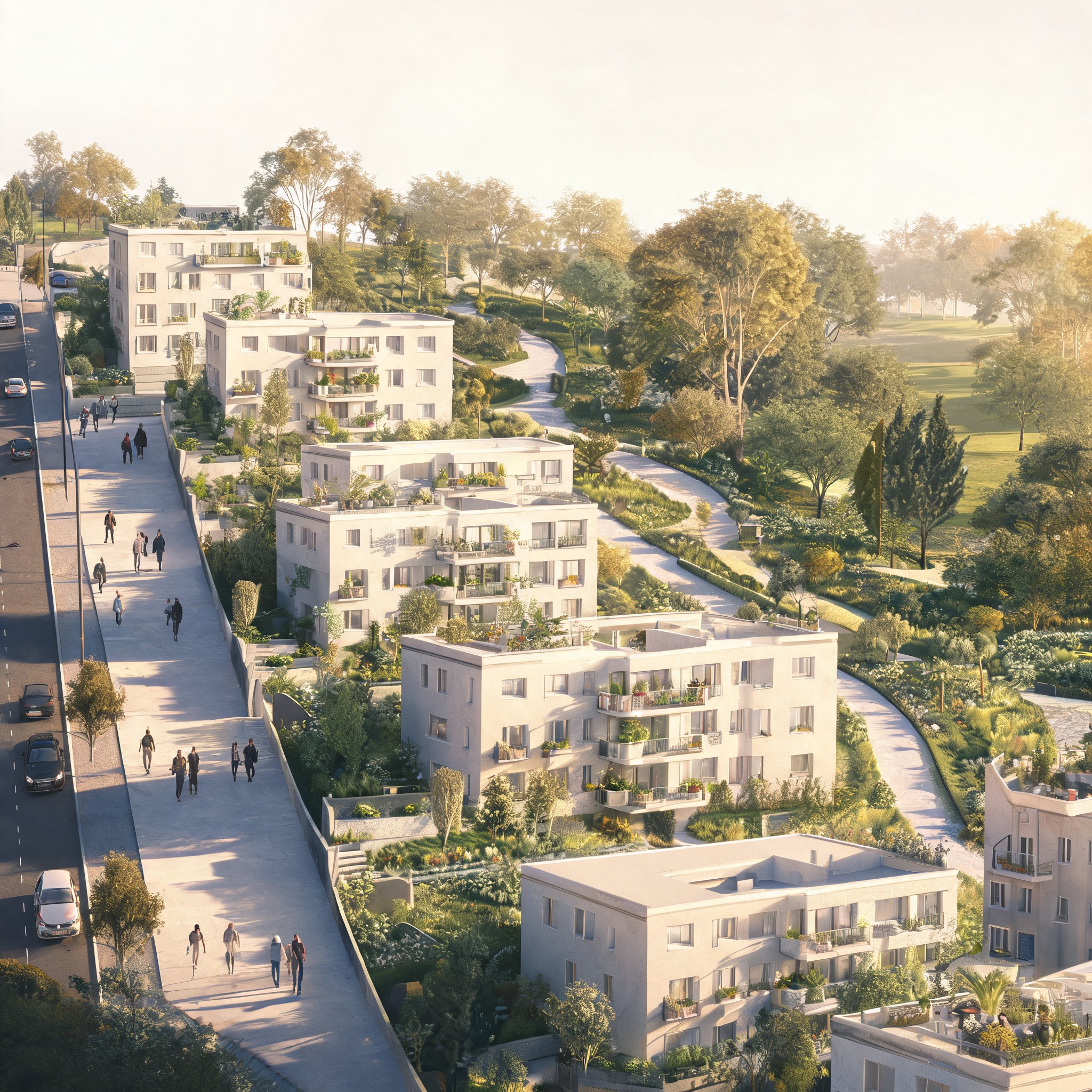
Lion Green Road, a 157-home council housing scheme in Coulsdon, south London, has won the RIBA Stirling Prize 2026. The development was designed by Mary Duggan Architects with RUFF Architects and delivered for Croydon Council by main contractor CField Construction under a £34 million deal.
The five-block scheme stands on the site of a former car park. The plot slopes markedly, changing level by eight metres across its length, and the design uses those shifts in height, together with the views they open up, to create what the project describes as a "living landscape" for the 635 people living there. The arrangement also forges a new connection between the busy Lion Green Road and a distinctive area of green parkland beyond.
Density without uniformity
Much of the jury's praise centred on how the scheme handles scale. A consistent specification runs across the five blocks, with subtle variation in height and orientation, so the development reads as one neighbourhood rather than a set of repeated buildings. The outcome, in the jury's words, is housing at scale without uniformity.
Chris Williamson, RIBA President, said on behalf of the jury that the scheme showed density can be achieved without compromising the quality of the places created, at a time when more homes are urgently needed. He described Lion Green Road as a new kind of garden neighbourhood that balances privacy and generous views with a strong connection to nature, and argued that it proves even the most challenging sites can be transformed into distinctive places for people to call home.
Lower-carbon delivery
The project account credits part of the scheme's environmental performance to how it was built rather than to its form alone. Efficient construction methods, simple finishes and a more streamlined building process allowed Lion Green Road to cut carbon emissions.
The award turns attention on a council-commissioned, contractor-built scheme delivered on a constrained urban site, a combination the jury framed as evidence of thoughtful, resourceful architecture serving a volume housing programme. Whether the approach transfers readily to other sites is not addressed in the citation, which focuses on the Coulsdon development itself, its construction approach and the public realm it creates.