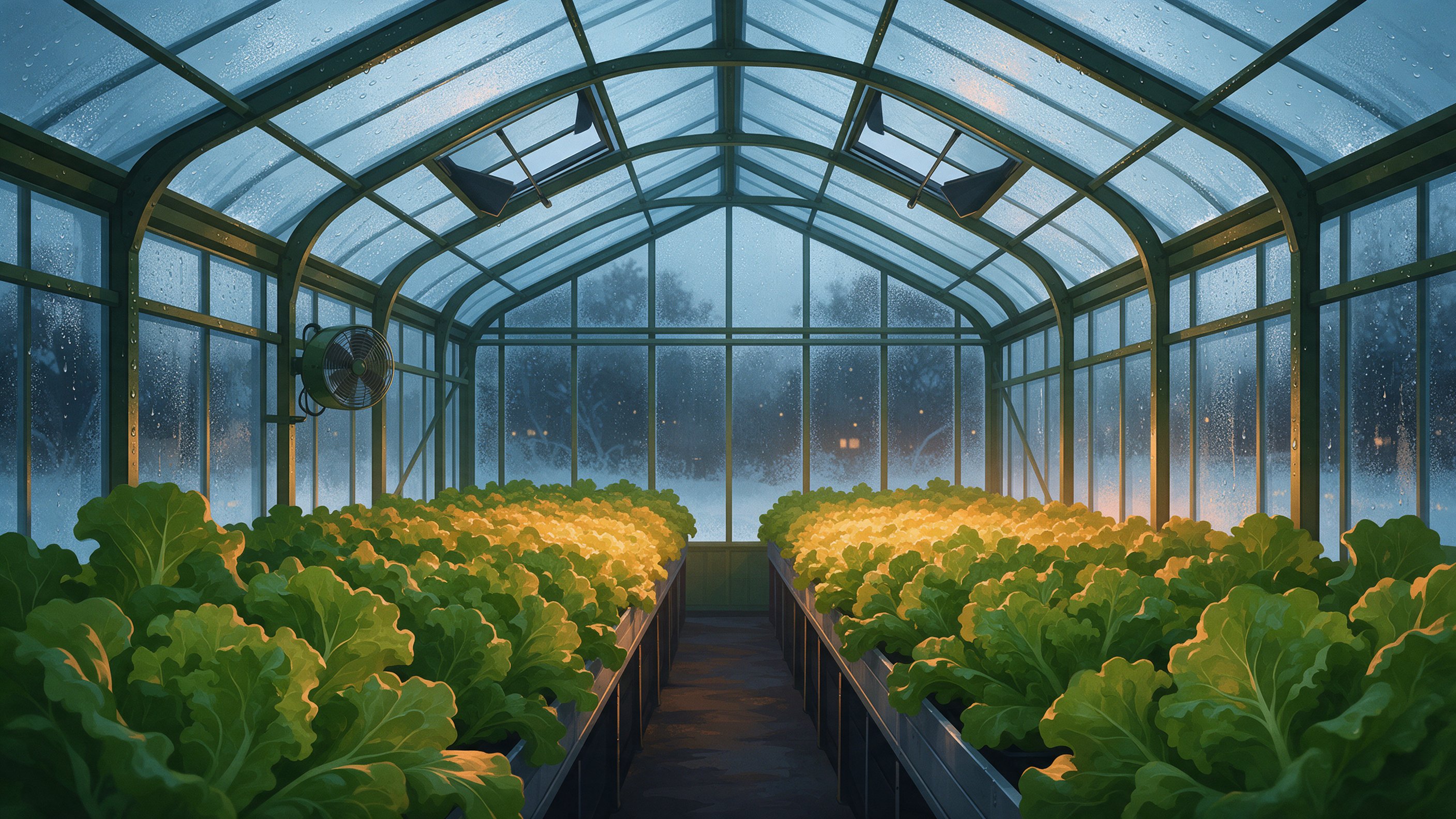
As outdoor temperatures fall and greenhouse vents and curtains stay closed to hold heat, moisture builds up inside the structure. The result is condensation on glazing, structural members and crop surfaces, longer periods of leaf wetness, uneven temperatures and greater disease pressure. Opening vents wide to dry the air, meanwhile, wastes energy and causes sharp temperature swings.
Managing this balance means coordinating heat, ventilation and air movement to protect the crop while keeping energy costs and plant stress down.
Why condensation, not relative humidity, is the real target
Relative humidity (RH) by itself does not predict whether water will form on plants. Condensation appears when a plant or greenhouse surface cools to the dew point of the surrounding air — the temperature at which RH reaches 100%. In cool weather, glazing, structural components and crop surfaces can sit below air temperature, letting free moisture collect on leaves and creating conditions favorable to foliar disease. Managing humidity is therefore less about holding a specific RH number and more about preventing condensation and the leaf wetness that follows.
How moisture accumulates overnight
Warm air holds more water than cool air. During the day, crops and substrate release moisture through evapotranspiration. As temperatures drop overnight, relative humidity climbs and condensation risk rises. Because greenhouses are usually sealed to conserve heat in cold weather, that moisture stays trapped, and without adequate air movement and ventilation the air can approach saturation by morning — especially in cool, stagnant zones.
Pairing heating with ventilation
Heating and venting look like opposing moves, but together they can be effective. Heating raises air temperature and lowers relative humidity, giving moisture a chance to evaporate from plants and surfaces. Ventilation then swaps the warm, moisture-laden interior air for cooler outside air — a practice often called "burping" the greenhouse. Used strategically, short heat-and-vent cycles remove moisture while limiting the energy loss that comes from leaving vents open for long periods.
Evening out microclimates with airflow
Greenhouse climates are rarely uniform. Cooler, more humid microclimates tend to form near sidewalls, corners, doors, curtains and within crop canopies. Horizontal Air Flow (HAF) fans mix air through the house, narrowing temperature and humidity differences between zones, and steady air movement also helps moisture evaporate from plant surfaces. HAF fans alone, however, do not remove moisture from the greenhouse, so air movement must be combined with appropriate ventilation once moisture levels climb.
In practice, humidity, heating and airflow behave as one connected system, so adjustments to any one of them shift the others and are best weighed together.