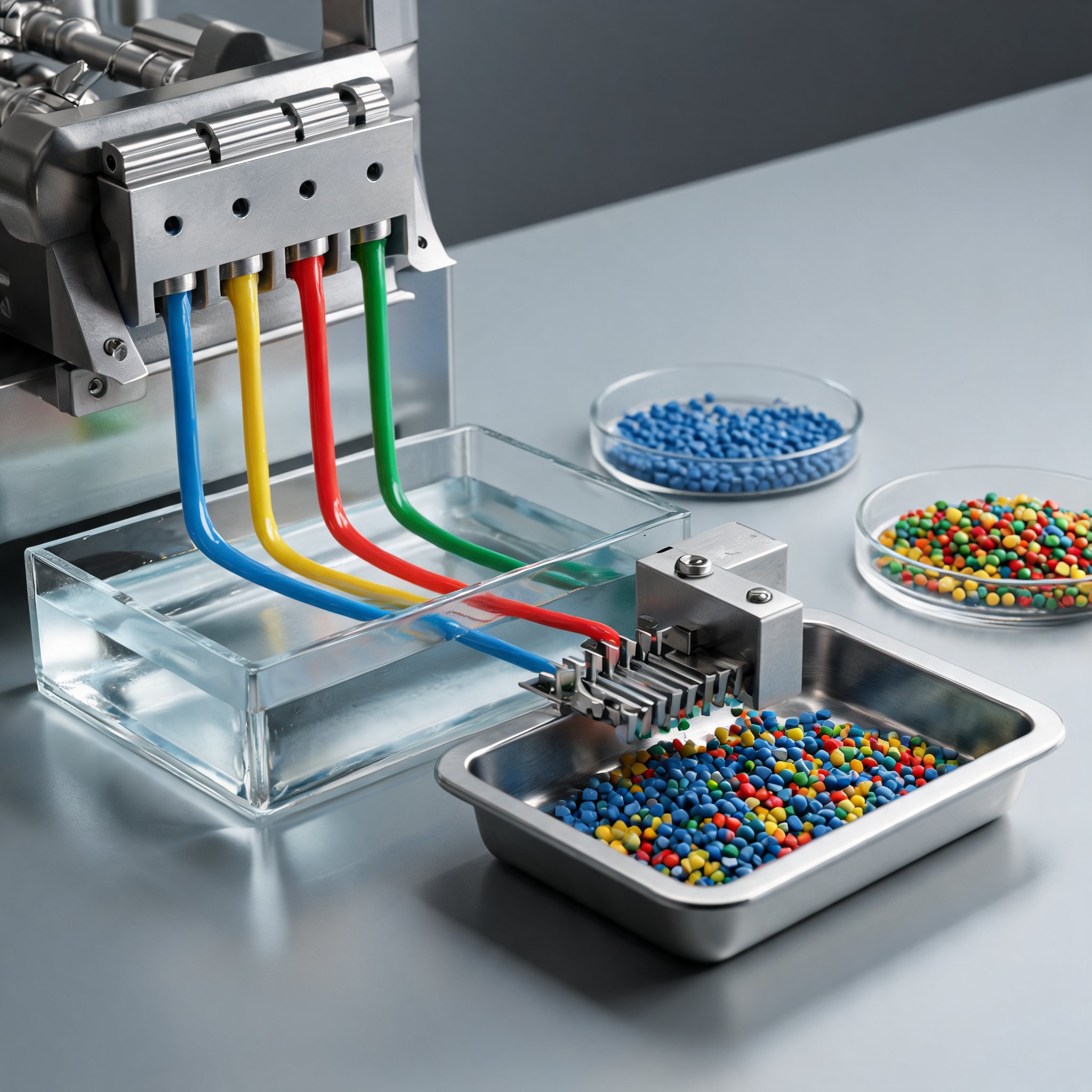
A study has tested whether four commercial natural colorants can be converted into colour masterbatches and compounded into two biodegradable polyesters without losing their function. The work, titled "Sustainability in the Development of Natural Pigment-Based Colour Masterbatches and Their Application in Biopolymers," used blue spirulina, yellow curcumin, red beetroot and green chlorophyllin, each paired with polylactic acid (PLA) and polybutylene succinate (PBS).
The concentrates were produced on a twin-screw extruder at 65 rpm and a feed rate of 2 kg/h, with titanium dioxide, calcium carbonate and stearic acid included to support UV protection, dispersion and processing. The masterbatches were then let down into the matching polymer at 2, 4 and 6 wt% and injection moulded into test specimens.
Thermal window set by pigment stability
Thermogravimetric analysis placed the degradation onset at roughly 229 °C for spirulina, 244 °C for curcumin, 258 °C for chlorophyllin and 267 °C for beetroot, all below the corresponding values for the two polyesters. The researchers therefore chose profiles that melted each matrix while limiting heat exposure: 145 °C for PBS and 190 °C for PLA.
That window suited most pigment–polymer pairs, with spirulina the clear exception. Processed in PLA at the higher temperature, it lost its characteristic blue colour, so no blue PLA masterbatch could be made. In PBS, where the lower melt temperature reduced thermal load, the same pigment held up well enough to be compounded. The authors read the contrast as evidence that compatibility depends strongly on how hot a given matrix must be processed.
Little disturbance to flow and strength
Rheology shifted only marginally. Melt flow rate dropped slightly after pigment incorporation, indicating a modest rise in melt viscosity; neat PLA measured about 50 g/10 min and the pigmented masterbatches stayed close to that figure, while PBS showed a similar minor reduction. From a compounder's perspective, conventional screw designs, pressure settings and moulding conditions largely carried over.
Mechanical testing spanned the full 2–6 wt% range. PLA began from a Young's modulus of about 1710 MPa and tensile strength of 65.6 MPa, PBS from roughly 392 MPa and 34.5 MPa. The coloured formulations remained near those baselines, and impact strength stayed within a comparable band, although individual pigments produced some scatter.
Colour retention over time proved the harder problem. After 50 hours of xenon-lamp exposure, most formulations exceeded a colour difference of ΔE* = 2, a level the authors treat as a visually perceptible change. The clearest exception was PLA containing 2 wt% chlorophyllin masterbatch, which was the most photostable system tested.
UV stability is therefore identified as the largest barrier to broader use. Packaging, consumer products, agricultural parts and outdoor applications would likely require additional stabilisation, protective coatings or pigment modification before natural colorants could compete with conventional systems across long service periods.
On environmental grounds the natural route scored better. Under the study's assumptions, one kilogram of curcumin pigment accounted for about 0.04 kg CO2-eq, against 18.65 kg CO2-eq for the inorganic green reference pigment, and the natural masterbatches also consumed less electricity during extrusion and pelletising.
The researchers conclude that several natural colorants can be compounded into PLA and PBS on conventional equipment with only limited changes in melt viscosity and mechanical performance, but that lightfastness and thermal stability still need development — both during processing and through subsequent service exposure.