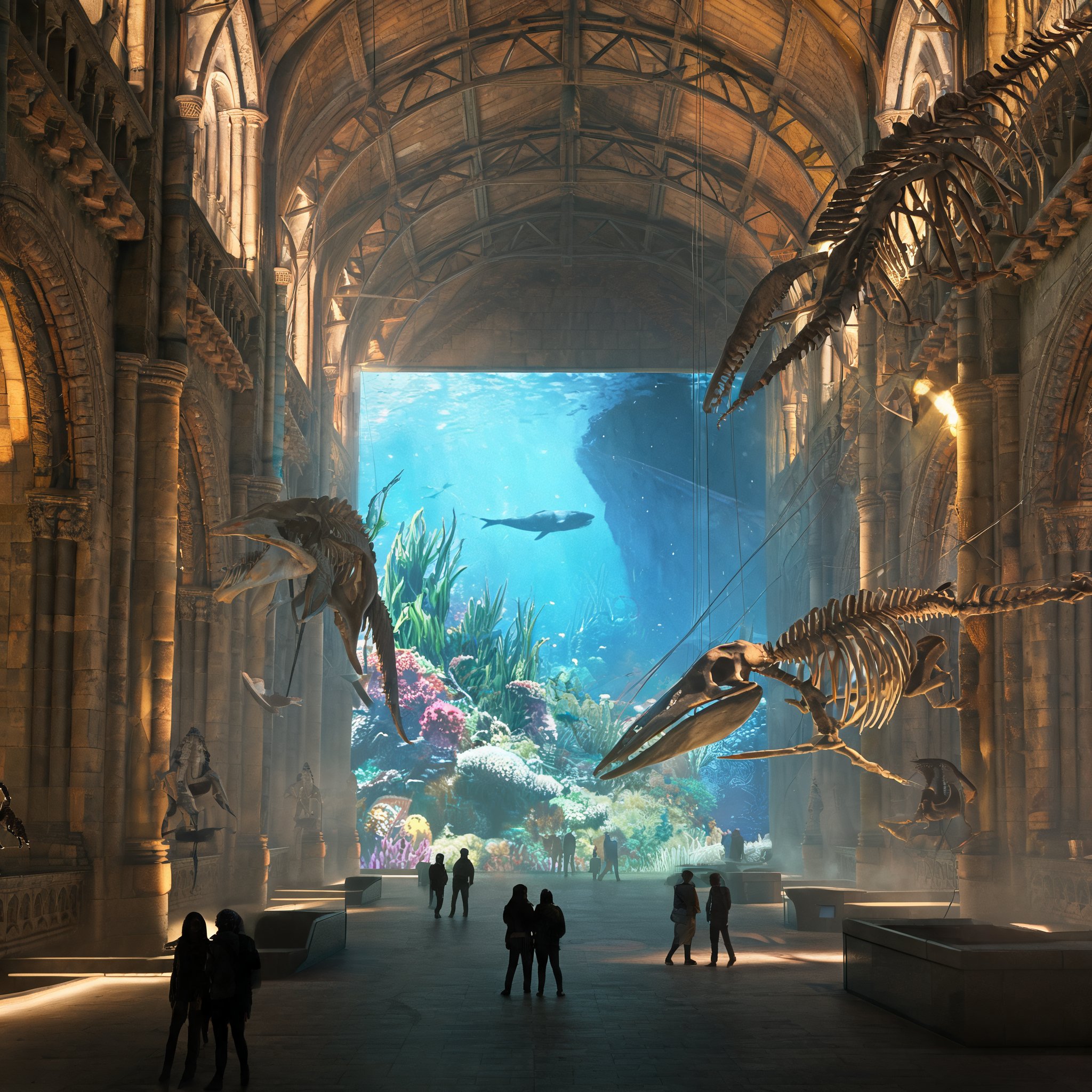
Oceano Odyssey - Mission Pelagos, the flagship experience of the Oceanographic Museum of Monaco’s Mediterranean 2050 programme, is built around a future in which long-term conservation in the Mediterranean has succeeded. Rather than centring environmental decline, the exhibition places visitors inside a scientifically credible vision of that outcome and asks them to consider a future worth protecting. The shift from warning to possibility is presented as a central design premise.
The project transforms the century-old Salle de la Baleine into the interior of a scientific research vessel. Its monumental architecture and suspended marine skeletons are not hidden by the technology; projection mapping, sound and scenography are used to reveal the historic space and make it part of the narrative. The installation is fully reversible and covers more than 310 m² of projection mapping, synchronised through Medialon show control and a Modulo Pi media server architecture. This approach is presented as a way for immersive design to enhance an iconic cultural space while preserving its identity.
A shared expedition
Visitors move through the exhibition together, without relying on headsets or individual devices. Guided by Captain Anita and her crew, families, school groups and international audiences follow a scientific expedition through seagrass meadows, coral habitats, deep canyons and open waters. The marine environment includes dolphins, fin whales, sperm whales and more than 30 Mediterranean species. Science is encountered through exploration rather than delivered only through interpretation, and the format is designed for a shared journey across generations.
The digital world was developed in Unreal Engine and recreates a scientifically informed 300 km² Mediterranean ecosystem. It brings together more than 866,000 digital assets, with the museum’s scientific teams involved from the earliest stages alongside designers, writers and digital artists. Their input shaped the narrative, the appearance and behaviour of marine species, the reconstruction of habitats and the overall visitor experience. The continuous dialogue between science and design is intended to make the result both emotionally engaging and scientifically credible.
Science, collections and technology
The exhibition also connects immersive media with the museum’s scientific collections. On the mezzanine, visitors encounter collections dedicated to the Mediterranean, setting contemporary digital storytelling alongside more than a century of research and observation. The design treats the two as reinforcing elements rather than separate attractions, creating a dialogue between historic observation and present-day media.
Technology is intended to sustain the exhibition’s illusion without becoming the main attraction. The project combines heritage, science, technology and storytelling within a single design approach, with each element serving the same goal: turning scientific knowledge into a shared cultural experience. In doing so, it proposes a model in which immersive design supports a museum’s educational mission, adds value to its architecture and invites visitors to see themselves as participants in the future they wish to protect.