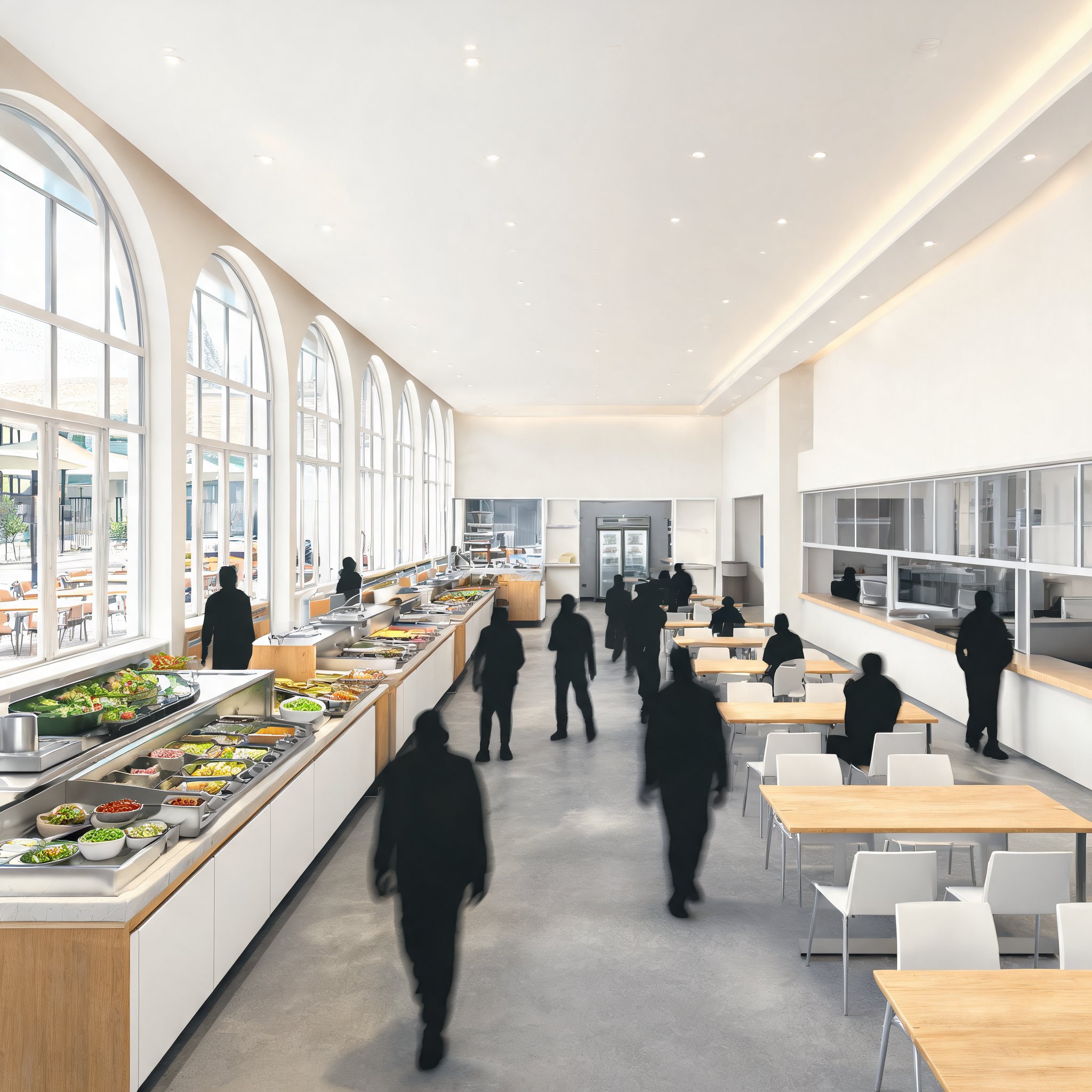
Texas Christian University has reopened its roughly 18-year-old Market Square dining facility as BLUU Dining in the Brown-Lupton University Union, addressing student perceptions that the old hall was a self-serve cafeteria with premade food. The project was part of a $17 million overhaul of the Union and opened in August 2026. TCU’s in-house design team set two goals: give students a reason to seek out the hall and increase meal-plan participation as the university grows.
The 13,000-square-foot dining area, with another 4,500 square feet for platforms and back-of-house, seats 550 indoors and 120 on a patio. Arched windows bring daylight into the salad, deli and to-go zone. The redesigned servery includes eight made-to-order platforms and Dash, a to-go window that opens into the entrance hallway so students can pick up a prepared sandwich or salad without entering the main dining room.
Research shifted the brief from speed to customization
Planning began in 2022 with surveys and focus groups. Jude Kiah, associate vice chancellor for student affairs business and operations, said the data showed students disliked the facility more than the food and viewed the old hall as a cafeteria for premade meals. They valued made-to-order food over faster service and were willing to wait for customized items. That finding shaped the platform mix and the layout, including moving salad, deli and to-go away from the main servery to give other stations more room. The move placed the platform beside windows overlooking campus and the stadium, and Kiah said it became the most popular space in the facility.
The early operating numbers are notable. Less than two months after opening, BLUU Dining was averaging 4,000 meals per day, double the count when the facility closed for renovation in December 2025, according to Kiah. The peak day reached about 5,700 meals, and he estimated the operation could produce 8,000 per day if pressed. Meal-plan enrollment stood at 6,300, with TCU expecting it to exceed 8,000 in the coming year. The university plans to add 2,500 campus beds next fall, adding pressure to dining capacity.
Back-of-house changes support the front
Miles Oller, director of facilities and operations, focused on service flow. A wide corridor replaced a narrow passage, and each platform has its own entrance, reducing competition for space. The support kitchen received a one-for-one replacement of most equipment after the team removed old tile flooring and installed epoxy flooring. An 800-square-foot walk-in cooler lets staff roll pallets directly inside, unload onto carts and distribute product more efficiently, said Scott Majestic, Sodexo district manager.
Equipment choices favored capacity, flexibility and maintainability. A rotating pizza oven can produce 116 pizzas an hour and bake casserettes on a lower level, while allowing one worker to load from the front and another to unload from the side without reaching into a 550-degree oven. Other selections include a customer-facing soft-serve machine, a round griddle that also serves as a plancha, and a pasta station that can switch to breakfast. The team generally preferred low-tech, durable equipment over computer-controlled units, and considered future repair costs and parts availability.
BLUU Dining follows East End, a dining hall that opened on the opposite side of campus in January 2025. The same TCU and Sodexo team led both projects, and the earlier work informed the choices at BLUU. Menus draw on Sodexo’s One & All higher-education program. Webb Foodservice Design handled equipment planning, CannonDesign was the architect, and Baring Industries and Mission Restaurant Supply served as dealers.
Kiah said BLUU Dining needed to have “some gravity” compared with East End and is doing so. The immediate task is operation: sustaining service speeds and menu variety as enrollment and residential capacity grow.