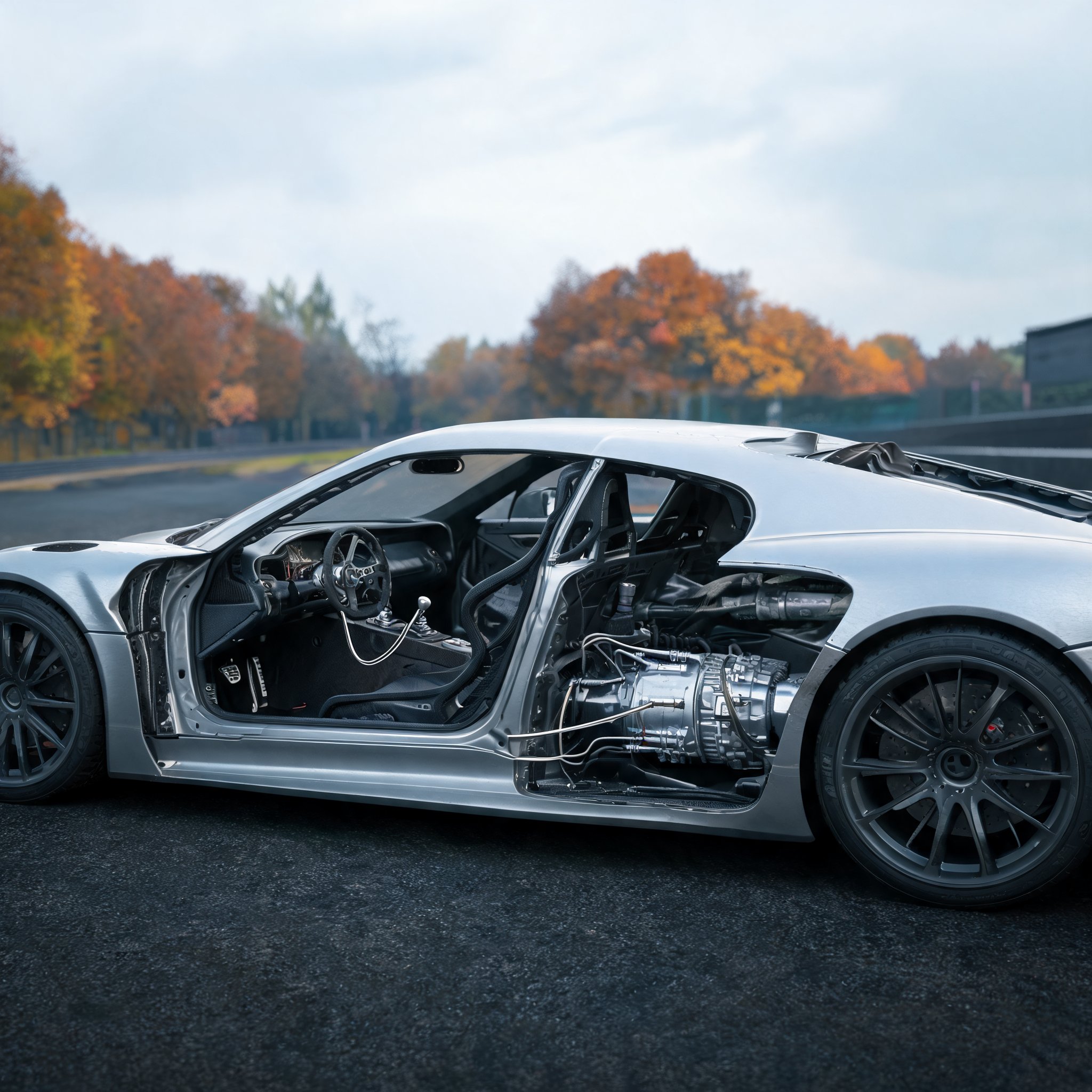
A manual-transmission C8 Chevrolet Corvette now exists as a running development vehicle, but it is not a factory option. Tremec, the supplier behind the six-speed manual used in GM performance models including the Cadillac Blackwings and the discontinued Camaro, built the car and allowed a journalist and several potential customers to drive it at Motorsports Gateway, a private track outside Howell, Michigan.
The vehicle was a one-of-one Peitz Performance C8 race car. It had a stripped, caged cockpit and a full harness; the shifter emerged from the space normally occupied by the storage cubby and automatic gear selector. This was a track evaluation, not a production-car review, and the author’s impressions were shaped by a fixed seating position set for a taller driver. At 5-foot-7, he could not reach the floor to heel-and-toe comfortably or brace himself in corners, limiting how hard he could push. The session also took place on a green track on a November afternoon in Michigan.
The drive was arranged for potential customers as well as the journalist, a reminder that Tremec is testing both hardware and market demand. The test car’s one-off status makes the conversion a demonstration, not a validated production system.
Why the C8 went automatic-only
Chevrolet’s decision to offer the C8 only with a dual-clutch automatic was rooted in cost. After decades of front-engine Corvettes, the mid-engine layout required new transaxles. Developing two—one manual and one automatic—was not in GM’s budget, the report states. The choice pitted a small group of manual enthusiasts against the performance credibility that comes from winning comparison tests against more expensive cars. GM chose the latter, producing a capable Corvette but leaving some drivers willing to trade a few tenths in the quarter-mile or lap time for the engagement of a manual.
What Tremec changed
The conversion did not require a bespoke mating system. Peitz had to cut the tunnel to install clutch-pedal hardware, but the manual transaxle otherwise sat where the stock dual-clutch unit would. The C8’s pedal box had enough room for a clutch pedal; even with the third pedal, the author found it roomier than a previous-generation Camaro’s.
The more consequential difference is the shifter. Because the gearbox is a transaxle at the rear, the shifter is remotely mounted and connected by cables. In front-engine cars using the TR-6060, the selector is mechanically linked directly to the transmission. The remote arrangement made the C8 application less precise and snick-snicky than its front-engine cousin, and less notchy. That may appeal to drivers who prefer a smoother action, while others may miss the more mechanical feel. Moving the engine forward would produce a C7; moving the shifter rearward would place the driver near the C8’s engine bay.
The cost is the real obstacle
The manual gearbox alone costs about $75,000, according to Tremec. Combined with the price of a Corvette, building a manual C8 carries a total that rivals a showroom-spec Z06. Tremec expects the price to fall as volume rises. It says OEMs are interested, not necessarily or exclusively General Motors. The gearbox was engineered to fit the C8, but other automakers have reportedly expressed interest in a high-torque manual transaxle. No customers were named.
For suppliers, that interest matters. A manual transaxle engineered for a low-volume, mid-engine platform could find a wider niche if other manufacturers need the same high-torque capability. But interest is not an order, and the C8-specific engineering does not guarantee a business case elsewhere.
That commercial detail matters more than the novelty of the build. The engineering case is now demonstrated: a manual transaxle can fit the C8’s mid-engine package without altering the fundamental layout, and the pedal box can accommodate a clutch. The business case is harder. A low-volume gearbox carries a high unit cost; a high unit cost limits the addressable market; and the addressable market was already described as a vanishingly small group of enthusiasts. The manual’s appeal is not a few tenths of performance but the operation itself—the clutch, the gate, the involvement. That value is real to buyers, but difficult to capture in a program that must justify two transaxles.
For Chevrolet, the obstacle is not packaging but the same budget calculation that produced the dual-clutch-only C8. A factory manual would have to justify its cost against the automatic’s role in comparison tests and the small number of buyers who want a third pedal. The one-off track car does not resolve that calculation. It proves the packaging problem is solvable; it does not prove the product decision has changed.
The Tremec car therefore serves as both proof and caution. It shows that the C8 does not inherently exclude a manual. It also shows why Chevrolet’s original decision was understandable: the automatic supports the Corvette’s broader performance mission, while the manual remains a specialized, costly variant. For now, the car is a one-off track development vehicle, not a showroom precursor. Its existence answers the engineering question; it does not settle the commercial one.